



In just the first 8 days of September 2026, courts caught 13 briefs riddled with AI hallucinations.
This included 14 fabricated cases, 11 misrepresented holdings, and 3 quotes that came not from case law but from the inscrutable inner workings of a large language model.
Seven of these briefs were written by pro se litigants. That means the other six came from lawyers.
When a lawyer relies on AI for legal work, who actually bears the responsibility?
The courts have made the answer clear, even if the details take some unpacking. Responsibility for legal work product stays with the lawyer and the firm. It doesn't transfer to a vendor, a tool, or an algorithm.
This is why it’s crucial to build the policies, oversight, and tooling that let your firm use AI correctly and with confidence.
This piece walks through the ethics rules, where vendors fit in, who’s accountable inside a firm, and how you can manage exposure while still getting the benefits of AI.
The Short Answer: Responsibility Stays With the Lawyer
Professional responsibility sticks with the lawyer. It cannot be delegated to a tool, no matter how sophisticated that tool is.
Think of AI the way you'd think of a very fast, occasionally overconfident associate: useful, sometimes brilliant, but never the one whose name goes on the filing. The attorney is the one who reviews the output, decides whether it's accurate and appropriate, and signs their name to the final work product. That review-and-approve step is where professional judgment lives, and it's not something AI can absorb on a lawyer's behalf.
Put simply: you cannot outsource accountability to an algorithm. AI can accelerate the work. It cannot accept the risk.
What the Ethics Rules Say
This principle isn't new: it's an extension of professional responsibility rules that firms already operate under. The rise of generative AI has just made a few of those rules newly relevant.
(Note that this is just a quick overview, not legal advice.)
- Duty of competence (Model Rule 1.1) and ABA Formal Opinion 512. In July 2024, the ABA's Standing Committee on Ethics and Professional Responsibility issued its first formal opinion addressing generative AI, confirming that a lawyer's existing duty of competence extends to understanding the benefits and risks of the AI tools they use, and to independently verifying AI output before relying on it. The opinion doesn't prescribe one-size-fits-all verification steps; how much scrutiny is required depends on the tool and the task. Reviewing an AI-drafted research summary calls for less independent verification than relying on AI to review documents for privilege. Either way, the duty of competence doesn't get satisfied by trusting the tool. It gets satisfied by verifying the output.
- Candor toward the tribunal (Model Rule 3.3) and meritorious claims (Model Rule 3.1). Filing a brief with fabricated or unverifiable citations, whether or not an AI tool generated them, is considered by the courts to be a candor problem, not a technology problem. The rule doesn't distinguish between a hallucination the lawyer wrote and one the lawyer copied.
- Supervisory responsibilities (Model Rules 5.1 and 5.3). Partners and managers are already responsible for the conduct of the lawyers and staff they supervise, and for the work of nonlawyer assistants. This responsibility reasonably extends to AI tools and the vendors who provide them. The supervisory duty doesn't pause just because the "assistant" in question is software.
How Liability Works When AI Gets It Wrong
Here's a reassuring point that's easy to miss: using AI doesn't require a new liability framework. Existing negligence and legal malpractice standards apply unchanged. A firm is still measured against the standard of care: what a reasonably competent attorney would have done under the circumstances.
What AI does change is the content of that standard. Using AI doesn't lower the bar for what's considered reasonable care; if anything, it can raise it, by adding a duty to actually oversee the tool you've chosen to use.
Outside the legal profession, the Air Canada chatbot case is a widely cited illustration of this principle in action. In 2024, a British Columbia tribunal held Air Canada responsible after its customer-service chatbot gave a passenger inaccurate information about bereavement fares. Air Canada argued the chatbot should be treated as a separate entity responsible for its own statements. The tribunal rejected that argument outright, finding that the airline was responsible for information provided through its own systems, whether that information came from a static webpage or an AI chatbot. The lesson generalizes well beyond airlines: the entity deploying the AI owns what the AI produces.
Inside the legal profession, the pattern has been even more direct. In the string of cases where attorneys filed briefs containing fabricated, AI-generated case citations, courts sanctioned the attorneys, not the AI tool. The tool made the error; the lawyer who filed it without checking bore the consequences.
Where Does the AI Vendor Fit In?
If the firm and the attorney are on the hook, where does that leave the AI vendor? The honest answer is: it's more complicated, and generally more limited than firms might hope.
Most AI terms of service include broad disclaimers of liability for the accuracy of generated output. Indemnification language and other contract terms are obviously still worth reviewing closely, and they can matter a great deal if something goes wrong. But even favorable contract terms can’t replace the lawyer's professional responsibility toward their client. That duty runs from the attorney to the client directly; it isn't something a vendor agreement can absorb by proxy.
Vendors can, in some situations, face their own separate exposure for product liability, misrepresentation about a tool's capabilities, or similar claims. But that's a distinct question from whether the lawyer met their duty to their own client. The two tracks run in parallel, not as substitutes for one another.
Who Within the Firm Is Responsible?
Responsibility for AI-assisted work doesn’t always rest with a single individual. It can be shared across several roles inside a firm:
- The individual attorney of record, who reviews and signs the final work product and bears primary responsibility for its accuracy.
- Supervising partners and managers, who under Model Rule 5.1 are responsible for ensuring the lawyers they supervise are using AI tools appropriately.
- The firm itself, which under Model Rule 5.3 bears responsibility for how nonlawyer staff (and, by extension, vendor tools) are used in client matters.
- Firm management, which carries the broader duty to establish clear, workable AI use policies in the first place, rather than leaving each attorney to improvise their own approach.
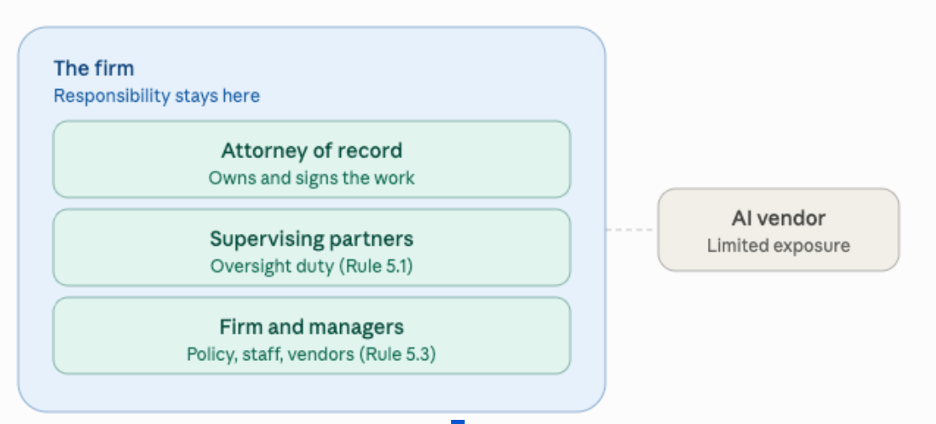
None of these roles cancels out the others. Responsibility is layered, not sequential: the fact that a supervising partner set a bad policy doesn't excuse the associate who ignored the verification step, and vice versa.
| Scenario | Who's Responsible | Why |
| An associate files a brief with AI-fabricated case citations. | The associate (and potentially the supervising partner) | The attorney of record is responsible for verifying every citation before filing, regardless of how it was drafted. |
| A firm-wide AI tool consistently produces unreliable summaries, and no one flags it. | Firm leadership / the partner who approved the tool | Failure to vet or monitor a tool used firm-wide is a supervisory and policy failure. |
| An AI vendor's tool has an undisclosed defect that caused the error. | The attorney still owes a duty to the client; the vendor may face separate exposure. | Vendor liability and attorney liability are separate tracks. One doesn't excuse the other. |
| An attorney relies on AI-drafted language without independent review, and it turns out to be wrong. | The attorney | The duty of competence requires independent verification proportional to the task. |
| A client isn't told that AI played a meaningful role in a key decision affecting their matter. | The attorney | The duty of communication (Model Rule 1.4) requires keeping clients reasonably informed about how their matter is being handled. |
How Firms Can Manage AI Liability and Exposure
Here are concrete steps every firm should take to protect itself from AI liability and exposure:
- A clear AI use and verification policy. Spell out which tools are approved, for which tasks, and what level of human review each task requires.
- Human review before anything reaches a client or court. No AI-drafted work product should go out the door without a human checking it against the standard the task demands.
- Training and documentation of standards. Attorneys and staff need to understand not just how to use a tool, but what "sufficient verification" looks like for the work they're doing.
- Vendor vetting and contract review. Understand what a vendor's terms of service actually say about liability, indemnification, and data handling before rolling a tool out firm-wide.
- Malpractice insurance considerations. Confirm with your carrier whether AI-related errors are covered under your existing policy or require an endorsement.
- Matching oversight to the stakes. A tool used to summarize deposition transcripts for internal reference doesn't need the same scrutiny as one drafting language for a filed motion. Calibrate review intensity to what's actually at risk.
How the Right Tools and Workflows Reduce Exposure
Policy is necessary, but the tools a firm uses can either make that policy easy to follow or nearly impossible.
Grounded, citation-backed, auditable AI tools make errors far easier to catch before they reach a client or a court, because the output points back to its source rather than asking attorneys to take it on faith. AI that operates inside a controlled, permissioned system (rather than a general-purpose tool disconnected from firm data) keeps the work reviewable and contained within the matter it belongs to. And audit trails that document human review do double duty: they support work-product quality, and they give a firm a clear record that its oversight process was actually followed if that's ever questioned.
LOIS Legal Research is built around this principle directly. Every citation it generates passes through a secondary verification layer before it reaches the attorney. If a case can't be verified, LOIS flags it as a potential hallucination. Citations link straight to the underlying opinion, with the exact relied-upon passage highlighted, so an attorney can confirm a holding in seconds instead of re-researching it from scratch.
Platform architecture also matters — maybe as much as the AI itself. Filevine's approach to data and systems, specialized tools, and core workflows is built around keeping AI output tied to case data and reviewable within a firm's existing process. It’s all reinforced by security and compliance controls designed for legal work specifically.
If you want a deeper look at how those capabilities fit together, this overview of the AI capabilities law firms need is a good next read.
Common Misconceptions About AI and Responsibility
A few myths tend to surface whenever this topic comes up. It’s worth clearing them up directly:
| Myth | Reality |
| "The AI or the vendor is liable, not me." | The attorney remains responsible for the work product they file or deliver, regardless of what tool produced the draft. |
| "Using AI lowers the standard of care." | It doesn't. It may even raise it by adding a duty to oversee the tool being used. |
| "A disclaimer in the tool protects the firm." | A vendor's terms of service don’t change the attorney's professional duty to the client. |
| "If the tool made the error, it isn't malpractice." | Failing to catch an error the standard of care required you to catch can itself be malpractice. |
Why Clear Accountability Is Good for Firms
It might seem like emphasizing where liability sits would make firms more cautious about AI. In practice, it's the opposite. Knowing exactly where responsibility lives is what lets a firm build the right guardrails and then adopt AI with confidence, instead of adopting it hesitantly or avoiding it altogether.
There's also a client-facing benefit. Clients trust firms that can clearly explain how they use AI and how they oversee it. As AI adoption becomes standard across the profession, the firms that can point to real governance have a genuine competitive edge.
How Law Firms Can Use AI Responsibly and Protect Themselves
The lawyer owns the work. That doesn't change because AI helped produce a first draft, summarize a deposition, or flag relevant case law. What does change is what "owning the work" requires in practice: a clear policy, proportional human review, informed vendor choices, and insurance coverage that actually matches how the firm uses AI.
What if firms just ban AI use? They’ll move more slowly than their competitors. But they’ll also likely face an additional problem of unauthorized AI use. AI tools have become so pervasive and helpful that restrictions tend to only drive their use underground. Professionals rely on their personal devices and unauthorized software, which only compounds the problem.
Instead, firms can use AI inside a system built for oversight, with tools that keep AI output grounded, auditable, and tied to the matter it belongs to. If you want to see what that looks like for your firm's workflows, request a LOIS demo and we'll walk through it together. You can also read how one defense firm cut unbillable work and got their evenings back using this approach, or explore our white paper on the future of AI in law for a broader look at where the profession is headed.
Frequently Asked Questions
Is the AI vendor liable when its tool produces a wrong answer? No, not to the client. A vendor may face its own separate exposure in some circumstances, but that's independent of the attorney's duty to their client. Most AI terms of service also disclaim liability for output accuracy, which is exactly why vendor contract review matters even though it won't shift professional responsibility.
Does using AI lower a lawyer's standard of care? No. The standard of care doesn't drop because AI was involved in producing a draft. If anything, courts and ethics regulators have signaled it may rise, since using a new tool competently includes understanding and overseeing its limitations.
Does malpractice insurance cover AI-related mistakes? It depends on the policy, and firms shouldn't assume either way. Some carriers are updating language specifically around AI use, while others treat it under existing negligence coverage. This is a conversation to have directly with your broker or carrier.
What does ABA Formal Opinion 512 say about responsibility for AI output? It confirms that a lawyer's existing duty of competence under Model Rule 1.1 extends to generative AI use, including independently verifying AI-generated output before relying on it. It doesn't set one fixed verification standard — how much review is required depends on the tool and the task — but it makes clear that uncritical reliance on AI output isn't compatible with the duty of competence.