


Every large firm evaluating AI eventually lands on the same question: how do we capture the efficiency gains without putting client confidentiality at risk?
It's the right question to ask, and for managing partners, general counsel, risk and compliance leaders, CISOs, and innovation officers, it's the one that determines whether AI adoption moves forward or stalls in committee.
The good news is that this isn't an either/or decision. AI and client confidentiality are fully compatible, but only when firms choose the right tools, put the right controls in place, and treat responsible adoption as an extension of the confidentiality obligations they already uphold every day.
Firms that get this right protect them and their clients from risk. They also build a genuine competitive advantage, because clients increasingly expect their counsel to use AI well and safely.
This guide walks through why confidentiality is a central issue with legal AI, what the ethics rules require, where exposure tends to creep in, and the concrete safeguards and governance practices that let large firms adopt AI with confidence.
Why Confidentiality Is the Central Consideration With Legal AI
Confidentiality is always an issue with AI tools. But for legal AI, it’s foundational.
Law firms hold some of the most sensitive data that exists: litigation strategy, trade secrets, medical records, financial disclosures, merger details, and privileged communications. That data must stay private. In many cases it's protected by an enduring duty of confidentiality and attorney-client privilege that survives the matter itself.
That combination — extremely sensitive data, held at scale, by organizations with valuable IP and deep pockets — makes firms high-value targets.
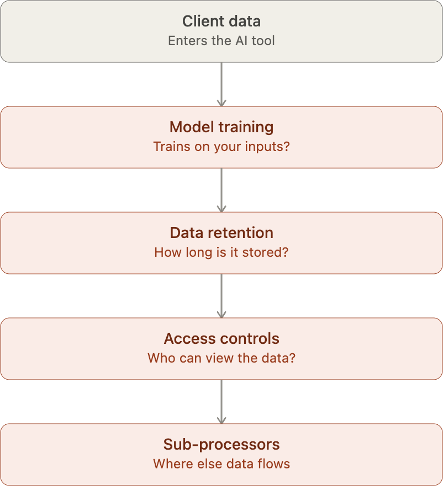
Add a new variable like generative AI into that environment, and any tool that mishandles inputs, retains data longer than expected, or routes information through unclear sub-processors becomes a meaningful new attack surface.
None of this is a reason to avoid AI. The efficiency gains are real: faster document review, faster drafting, faster research, more time for the judgment work that actually requires a lawyer. The goal is to adopt AI in a way that's safe by design, so firms don't have to trade efficiency for privacy.
What the Ethics Rules Say About AI and Confidentiality
The ABA has clearly weighed in on the issue of confidentiality and AI, and state bars are following.
ABA Formal Opinion 512, issued July 29, 2024, is the ABA's first formal guidance on generative AI in legal practice. It applies several existing Model Rules to AI use. But the confidentiality piece is the one every firm needs to internalize: under Model Rule 1.6, lawyers must protect all information relating to a representation, regardless of its source. It also clarifies that firms are responsible for understanding how a given AI tool actually uses the data put into it.
The opinion's practical takeaway is direct: before client information goes into a self-learning AI tool, lawyers generally need the client's informed consent. And "informed consent" sets a real bar. A single line of boilerplate buried in an engagement letter, written before the firm even knew which tools it would use, typically doesn't meet it. Meaningful consent means the client actually understands, in reasonably specific terms, that AI may be used on their matter and what that means for their information.
It's also worth knowing that Opinion 512 is a floor, not the whole picture. State bars — including California, Florida, New Jersey, New York, and Pennsylvania, among others — have issued their own guidance, and some go further than the ABA's baseline. Firms operating across multiple jurisdictions should confirm what applies where they practice.
(This is general, explanatory information about the ethics landscape, not legal advice — firms should consult their own ethics counsel on how these rules apply to their specific practice.)
Where Confidentiality Gaps Can Appear (and How to Prevent Them)
Some AI confidentiality failures are dramatic hacks and breaches. But most are quiet, structural gaps. Knowing where they tend to show up is the first step to closing them:
- Tools that train on user input. If a model learns from what's typed into it, client information can end up influencing outputs shown to other users, or persisting in ways the firm never intended.
- Shadow AI. Attorneys and staff might use public, consumer-grade chatbots for client work, often with good intentions and no bad faith, outside of any firm-sanctioned tool or policy.
- Unclear data retention. Firms might now know how long a vendor stores inputs, or whether "deleted" actually means deleted.
- Sub-processors and unclear data flows. A vendor's AI feature may quietly route data through other companies' infrastructure that the firm never vetted directly.
Each of these is a gap a firm can design out with the right tool selection, the right prompting discipline, and the right policy backing it up. None of it requires avoiding AI altogether.
Core Safeguards for Using AI Confidentially
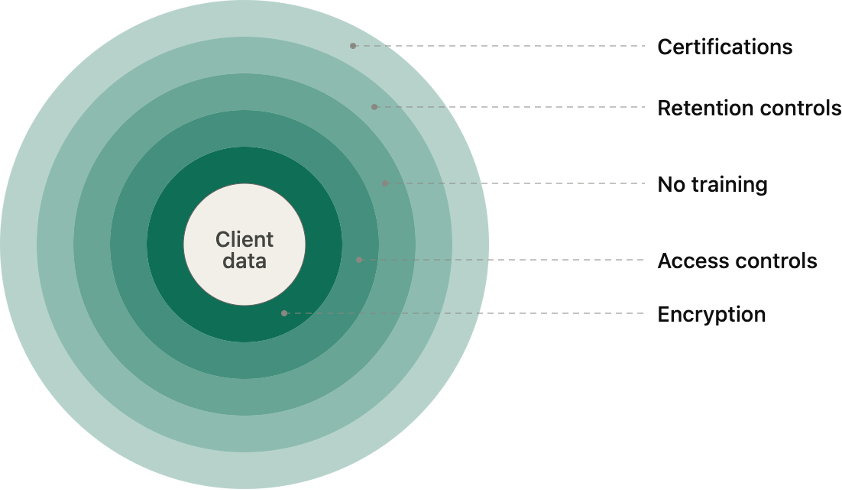
The safeguards that make AI safe for confidential legal work are the same controls firms already expect from any system handling client data.
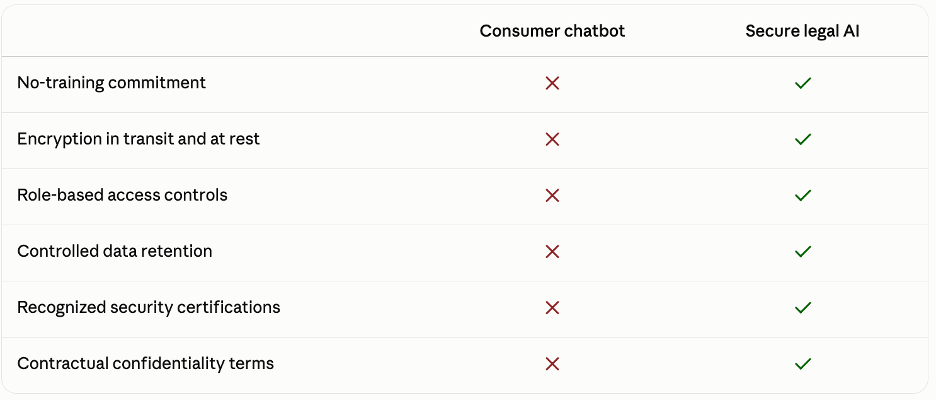
- Closed models or contractual no-training commitments ensure a firm's data isn't used to train the underlying model. Make sure it’s guaranteed in writing, not just implied.
- Encryption in transit and at rest, so data is protected both while it moves and while it sits.
- Role-based access controls, so only the people who need to see a matter's data can see it.
- Data minimization and redaction, limiting what goes into a tool in the first place.
- Controlled or no data retention, so inputs don't linger longer than the firm intends.
- Recognized certifications and independent compliance validation, giving the firm evidence that controls are actually in place.
This is defense in depth: no single safeguard has to do all the work, because the layers back each other up. It's also exactly what a secure, compliant legal platform is built around, with data and systems architecture designed to keep client information controlled at every layer rather than bolted on after the fact.
How to Vet AI Vendors and Tools for Confidentiality
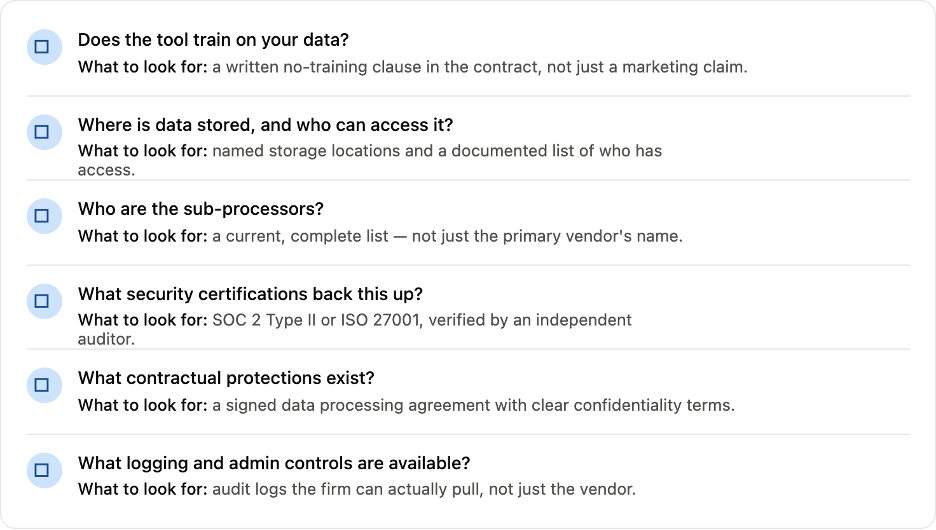
Every AI tool a firm considers, whether it's a standalone product or a feature inside a platform the firm already uses, deserves the same due diligence a firm would apply to any vendor handling client data. A few questions should be non-negotiable:
- Does the tool train on our data? Read the actual terms of service and data-use terms, not just the marketing page.
- Where is the data stored, and who can access it?
- Who are the sub-processors, and does the firm actually understand the full data supply chain, not just the primary vendor?
- What security certifications and independent audits back up the vendor's claims?
- What contractual protections exist — data processing agreements, confidentiality terms, breach notification obligations?
- What logging, auditability, and admin controls does the firm get, so it can actually see how the tool is being used?
This diligence is an extension of the firm's supervisory duty under Model Rule 5.3, which requires lawyers to make reasonable efforts to ensure nonlawyer service providers, including AI vendors, handle client information consistently with the lawyer's own professional obligations.
When to Get Client Informed Consent
Meaningful informed consent goes far beyond a boilerplate clause. It means the client understands, in terms specific enough to matter, that AI may be used, what kind of information might be involved, and what protections are in place. It also means the firm is documenting that consent and keeping a record of it, rather than just checking a box once and moving on.
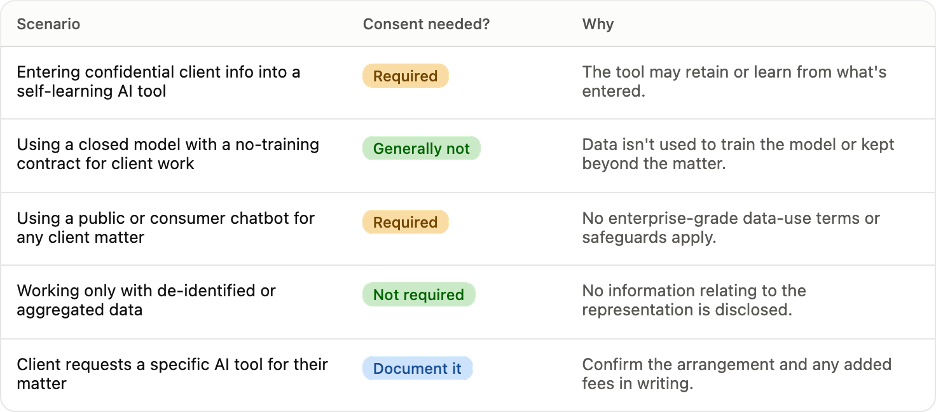
Informed consent isn't required every time a firm uses AI. It's tied to a specific trigger: putting client confidences into a tool that could retain, learn from, or otherwise lose control of that information. Under ABA Formal Opinion 512, that's the line. If an AI tool is self-learning — meaning it trains on what's entered into it — client information could end up influencing outputs shown to other users or persisting somewhere the firm never intended. That's a material change to how confidential information is being handled, and clients are entitled to know about it and agree to it before it happens.
By contrast, using a closed model with a contractual no-training commitment generally doesn't require separate consent, because the tool isn't introducing that same disclosure risk. It functions more like any other vetted piece of secure legal software the firm already uses.
Note that this is the ABA's baseline, not a universal rule. Some state bars (and some engagement letters or client-specific instructions) may still expect disclosure or consent as a matter of client relations, even where it's not strictly required.
Also, consent and disclosure aren't identical. Some firms choose to disclose AI use as a matter of transparency and client relationship management even when consent isn't technically required. That's a business judgment, not an ethics obligation.
Client consent and disclosure deserve their own deeper treatment; for a closer look at when and how to communicate AI use to clients, see our companion piece on how law firms should disclose AI use to clients.
Building a Confidentiality-First AI Governance Program
For large and enterprise firms, individual safeguards aren't enough on their own. They need to be backed by a governance program that works at scale. That typically includes:
- A firmwide AI policy and an approved-tools list, so attorneys know exactly what's sanctioned and shadow AI has nowhere to hide.
- Access tiers and matter-based permissions, so AI tools respect the same information barriers the firm already maintains.
- Firmwide training, so every attorney and staff member, not just the early adopters, understands how to handle client data around AI correctly.
- Clear supervisory responsibilities, so partners and practice group leaders know they're accountable for how AI is used on their matters.
- Incident response procedures and documentation, so if something does go wrong, the firm has a defined process rather than an improvised one.
One practical reality worth naming: an integrated, secure platform is far easier to govern than a patchwork of disconnected point tools. Every additional standalone AI tool is another vendor to vet, another data flow to map, and another gap for shadow AI to fill. Firms that consolidate their core workflows and specialized tools on a single, secure platform reduce that governance burden considerably. One defense firm that did so was able to cut unbillable work and get evenings back without compromising on data control.
Common Misconceptions About AI and Confidentiality
A few myths tend to stall AI adoption unnecessarily. It's worth naming them directly:
"All AI tools train on your data." Not true. Closed, private-model tools with contractual no-training commitments exist specifically to avoid this, and they're increasingly the norm for enterprise legal tools.
"Using AI automatically waives privilege." Using AI itself doesn't waive privilege. What creates risk is putting privileged information into a tool without adequate safeguards around confidentiality and third-party disclosure. This is a controllable input, not an inherent feature of AI.
"You can't use AI on confidential matters at all." Firms use AI on confidential and privileged matters every day, safely, with the right tool and the right controls in place. Avoidance isn't the safeguard; informed, deliberate adoption is.
"A consumer chatbot is the same as an enterprise legal tool." These are not remotely comparable. Consumer tools are typically built for broad public use, often with different data-handling terms and training practices. Enterprise legal AI tools are built from the ground up around confidentiality, access control, and auditability.
How Big Law Firms Can Adopt AI With Confidence
Confidentiality and AI have to be solved together, and firms that get this right prove it's possible every day. The path isn't complicated: understand what the ethics rules require, close the specific gaps where exposure tends to appear, build in the core technical safeguards, vet vendors with real diligence, get informed consent when it's needed, and back all of it with governance that scales across the firm.
Doing this well makes AI adoption durable. Responsible, secure AI use is becoming a hallmark of a well-managed firm, and clients notice the difference.
If your firm is ready to move from evaluating AI to adopting it with a platform built around security and compliance from the ground up, request a demo to see how LOIS, the Legal Operating Intelligence System built by Filevine, supports confidential AI use at scale.
Frequently Asked Questions
Do AI tools train on the data lawyers enter into them
No, not all of them. Some AI tools do train on user inputs, but closed, enterprise-grade tools frequently offer contractual no-training commitments specifically so client data is never used to improve the underlying model. The key is confirming a specific tool's data-use terms rather than assuming one way or the other.
Does a firm need client consent to use AI on a matter?
It depends on the tool and how it's used. Under ABA Formal Opinion 512, informed consent is generally required before client confidences go into a self-learning AI tool, though the specific requirements can vary by state bar and by the nature of the data involved.
What does ABA Formal Opinion 512 say about confidentiality and AI?
Issued July 29, 2024, it holds that lawyers must understand how a given AI tool uses data and put safeguards in place under Model Rule 1.6, and that informed client consent is generally needed before confidential information is entered into self-learning AI tools.
What should a law firm look for in a secure AI tool?
At minimum: no-training commitments or a closed model, encryption in transit and at rest, role-based access controls, controlled data retention, recognized security certifications, and clear contractual protections around how vendor and sub-processor data flows work.